

Ask any driving instructor what catches learners out most on test day, and the answer is almost always the same. UK roundabouts. They appear on virtually every driving test route in the country; they demand split-second decisions, and they combine several of the most commonly faulted skills into one high-pressure moment.
According to the DVSA’s official driving test fault statistics, junctions and road positioning, the two areas where UK roundabouts feature most heavily, sit consistently at the top of the national failure list year after year. Understanding exactly why learners fail at roundabouts is, therefore, one of the most valuable things you can do before your test date.

Why UK Roundabouts Are So Difficult on a Driving Test
More Decisions in Less Time
A roundabout compresses several driving skills into a matter of seconds. You need to assess the correct lane on approach, check for traffic already on the roundabout, signal at the right moment, maintain your position through the junction, and exit cleanly without cutting across other vehicles. Do all of that for the first time on an unfamiliar roundabout, under test pressure, and the margin for error becomes very small indeed.
The Stakes Are Higher Than on Straight Roads
On a straightforward road, a minor lapse in observation might result in a minor fault. On a UK roundabout, the same lapse can easily escalate to a serious or dangerous fault because the consequences for other road users are more immediate. Other drivers are moving through the junction at the same time, and any misjudgement on your part directly affects them.
This is why targeted practice on the specific roundabouts your examiner will take you to is so important. Familiarity converts a high-pressure moment into a routine one.
7 Real Reasons Learners Fail at UK Roundabouts
1. Choosing the Wrong Lane on Approach
Lane discipline on approach is the foundation of every roundabout manoeuvre, and it is also where many learners go wrong before they have even entered the junction. Choosing the wrong lane on approach forces a series of corrections inside the roundabout, and each correction creates a new opportunity for a fault.
The Highway Code guidance on roundabouts sets out clear rules for lane selection based on your intended exit. For exits on the left or straight ahead, you should generally approach in the left lane. For exits on the right or going more than halfway around, you should approach in the right lane. In practice, however, many real UK roundabouts do not follow a clean layout, and the correct lane is not always obvious from the road markings alone.
Consequently, learners who have never driven a specific roundabout before are essentially guessing. Those who have practised it beforehand know exactly which lane to take before they arrive at it.
2. Failing to Give Way to Traffic Already on the Roundabout
Emerging onto a roundabout without giving way to traffic that is already circulating is one of the most common serious faults recorded on UK driving tests. It is also one of the most dangerous, as it forces other drivers to brake suddenly or swerve to avoid a collision.
The rule itself is simple. Traffic on the roundabout has priority over traffic entering it. In practice, however, the judgement of when a safe gap exists is much harder than it sounds, particularly on busy multi-lane roundabouts where vehicles are approaching from multiple directions at once.
Furthermore, test nerves play a significant role here. Learners who feel pressure to keep moving, rather than waiting for a genuinely safe gap, are far more likely to emerge too early. Repeated practice on the real roundabouts your examiner uses builds the judgement needed to read those gaps accurately and confidently.
3. Signalling at the Wrong Time or Not at All
Signalling errors on UK roundabouts are surprisingly common and cover a wide range of mistakes. Some learners forget to signal entirely when exiting. Others signal too early, confusing drivers behind them about which exit they intend to take. Still others signal on approach when they should not, or fail to cancel their signal after exiting.
As confirmed by the DVSA’s guidance on what happens during your driving test, the examiner will assess your signalling throughout the test, including every roundabout you pass through. A consistent pattern of incorrect signalling will accumulate minor faults quickly, and a single serious signalling error can end the test.
The correct sequence for most roundabouts is to signal left as you pass the exit before the one you intend to take. Practising this sequence repeatedly on familiar roundabouts is a good start, but practising it on the specific UK roundabouts on your test route is far more valuable.
4. Poor Observation Inside the Roundabout
Many learners focus so heavily on entering the roundabout safely that they neglect their observations once they are actually on it. Poor observation inside the roundabout, specifically failing to check mirrors and blind spots before changing lanes or exiting, is a frequent source of serious faults.
This is particularly relevant on multi-lane roundabouts, where other vehicles may be travelling alongside you through the junction. Changing lanes or exiting without checking your mirrors and blind spot puts those vehicles at risk, and the examiner will record a serious fault if it creates a genuine hazard.
Moreover, the cognitive load of managing a complex roundabout for the first time makes it harder to maintain full observation habits. Familiarity with the junction removes much of that cognitive load, freeing you to focus on your driving technique rather than figuring out where you are going.
5. Losing Speed or Hesitating Mid-Roundabout
Hesitating or slowing unnecessarily once you are already on a roundabout is a fault that many learners do not anticipate. Once you have entered a roundabout and committed to a gap, maintaining a consistent and appropriate speed is essential. Slowing unexpectedly inside the junction can cause the vehicle behind you to brake sharply, which in turn can result in a serious fault for the candidate at the front.
This type of fault is almost always linked to uncertainty about the route. A learner who is unsure which exit to take will naturally slow down to buy thinking time. In contrast, a learner who already knows the roundabout, already knows which exit they need, and has driven it before will maintain speed naturally and confidently.


6. Cutting Across Lane Markings on Exit
Exiting a roundabout cleanly requires the same precision as entering it correctly. Drifting across lane markings on exit, either by cutting in from the right lane or by swinging wide from the left lane, is a positioning fault that regularly appears on the list of major faults at UK roundabouts.
The fault tends to happen when candidates are relieved to be nearly through the junction and relax their attention too early. Alternatively, it happens when the exit geometry is unfamiliar, and the candidate misjudges the correct line through it.
Knowing the exit layout of a specific roundabout before you drive it is, therefore, a genuine advantage. Similarly, practising the correct exit line repeatedly in a low-stakes environment builds the muscle memory to reproduce it correctly under pressure.
7. Not Practising the Specific Roundabouts on Your Test Route
This is arguably the most significant reason learners fail at UK roundabouts, and it underpins every other point on this list. General roundabout practice, even a lot of it, does not prepare you for the specific challenges of the roundabouts your examiner will take you to.
Every roundabout is different. The lane markings vary, the sightlines vary, the traffic volume varies, and the correct approach for each one is shaped by its specific geometry. A learner who has practised dozens of roundabouts in their local area but has never driven the ones on their test route is still approaching those junctions for the first time on test day.
This is the exact problem that RouteBuddy solves. Rather than practising roundabouts in general, RouteBuddy puts you on the actual routes used by DVSA examiners at your test centre, including every UK roundabout the examiner is likely to take you through. By the time test day arrives, those junctions are already familiar.
How RouteBuddy Helps You Master UK Roundabouts Before Test Day
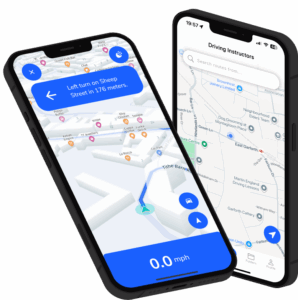
RouteBuddy gives learner drivers across the UK access to the real routes used by DVSA examiners at test centres nationwide. Turn-by-turn voice guidance mirrors the independent driving section of the test itself, so you practise following directions through real junctions rather than imaginary ones.
For UK roundabouts specifically, this means you can practise the correct lane approach, the right signalling sequence, and the correct exit line on the exact roundabout your examiner will use, before you sit your test. Every route in the app is kept up to date with current road layouts and lane markings, so what you practise accurately reflects what you will face on test day.
Practical Steps to Nail UK Roundabouts on Your Test
- Study the Highway Code rules for roundabouts at the official Highway Code on GOV.UK
- Use RouteBuddy to drive your test centre’s routes and practise the specific roundabouts your examiner will use
- Practise the sat-nav section using RouteBuddy to simulate your real test routes so following directions becomes automatic
- Ask your instructor to focus at least one full lesson on the roundabouts on your test route
- Check your test centre’s most common faults using DVSA statistics on GOV.UK
- Do a full mock test on the real routes with no prompting, paying particular attention to roundabout signalling and positioning
- Practise at the same time of day as your actual test slot, since traffic volume changes how roundabouts behave
The Bottom Line: UK Roundabouts
UK roundabouts fail more learners than almost any other feature of the practical driving test. However, the reasons behind those failures are consistent, predictable, and entirely preventable. Wrong lane choice, poor observation, hesitation, and unfamiliarity with the specific junction all come down to one root cause: not having driven those roundabouts before.
The solution is straightforward. Drive the roundabouts on your test route before test day. Know the lanes, know the exits, know the signalling sequence. With the right preparation behind you, UK roundabouts stop being the thing that ends your test and start being the thing that proves you are ready to pass