

Failing the UK driving test stings. You have put in the hours, paid for the lessons, and sat in that examiner’s seat feeling as if you had it, only to be handed a sheet full of faults at the end. It happens to more people than you might think, and in most cases it comes down to gaps in UK driving test practice rather than a lack of ability behind the wheel.
According to the DVSA’s official driving test statistics, the overall pass rate for the practical driving test in the UK hovers around 47 to 49 percent. That means roughly one in every two candidates walks away without a licence on their first attempt. The good news is that the vast majority of failures come down to the same handful of mistakes, and every single one of them is fixable with targeted UK driving test practice.
This article breaks down the most common reasons learners fail, what examiners are specifically looking for, and how building your practice around real test routes can genuinely change the outcome on test day.

Why UK Driving Test Practice Is the Difference Between Passing and Failing
There is a big difference between being able to drive and being ready for a test. Your instructor might tell you that you are a confident driver and they are probably right. But confidence behind the wheel in familiar surroundings is not the same as performing under pressure on roads you have never driven before, in a specific sequence, with a stranger sitting next to you writing things down.
Targeted UK driving test practice means rehearsing the actual conditions of the test itself. That includes the roads the examiner will take you on, the junctions you will have to navigate, the roundabouts that catch people out, and the sat-nav section you will need to handle independently. When you have driven those roads before, the fear of the unknown disappears. What is left is just driving — and that is when people pass.
7 Common Reasons Learners Fail Their UK Driving Test
1. Junctions: The Single Biggest Cause of Test Failures
Year after year, the DVSA publishes its list of the most common test faults, and junctions sit at the very top. According to GOV.UK’s data on driving test failures, incorrect observations at junctions account for tens of thousands of failures every year across the UK.
The fault usually falls into one of two patterns:
- Emerging too early – pulling out without waiting for a proper gap in traffic
- Poor observation – not looking effectively in both directions, or relying on a glance rather than a proper check
Junctions feel routine during lessons because your instructor tends to pick roads you are familiar with. On a test, the examiner might take you to a T-junction you have never seen, at a busier time of day, with a lorry approaching from the left. If you have not practised that specific junction, the surprise alone can throw you.
This is exactly why route-based UK driving test practice matters. When you already know that the route from a test centre takes you onto a busy A-road and includes a blind junction on a residential street nearby, you approach it with a plan rather than a reaction.
2. Mirrors: Checking Them Is Not Enough; You Have to Show It
The second most common cause of failure is mirror use, specifically failing to check mirrors before changing speed or direction, or checking them but not clearly enough for the examiner to see.
This is one of the more frustrating faults because many learners do check their mirrors. The problem is they do it too subtly. A flick of the eyes is not enough. Examiners are watching your head movement. If they cannot see that you have checked, as far as the test is concerned, you have not.
As the DVSA explains in its official guidance on what happens during your driving test, the examiner will mark you on your use of mirrors in relation to signalling, changing direction, and changing speed throughout the entire test, not just at obvious moments.
The fix is deliberate exaggeration during practice. Make your mirror checks obvious. Before signalling, before braking, before changing lanes, turn your head just enough that it is unmistakable. It feels unnatural at first, but it becomes habit quickly with consistent UK driving test practice.
3. Positioning on the Road: More Nuanced Than It Sounds
Incorrect road positioning is another recurring fault. It covers a surprisingly wide range of situations:
- Drifting too close to parked cars on residential streets
- Taking the wrong lane at a roundabout
- Positioning too far left or right when turning
- Not keeping left on narrow roads when a vehicle approaches
The roundabout problem deserves particular attention. Multi-lane roundabouts are where a lot of tests are lost, and nearly every test centre in the UK has at least one nearby. If you are taking your test in a city like Birmingham, Manchester, or Bristol, the chances of hitting a complex roundabout in the first ten minutes are high.
The Highway Code rules on roundabouts are clear on lane discipline, but knowing the rules and applying them under pressure on an unfamiliar roundabout are two different things. Practising your specific test centre’s route means you can identify those roundabouts in advance and walk through the correct lane discipline before you ever sit the test.
4. Steering: Losing Control at the Wrong Moment
Steering faults typically come in two forms on the scoresheet: steering too early when turning, and making wide turns that cross lane markings. Both are signs of a driver who has not fully internalised the geometry of their car.
This usually improves naturally with time and mileage. If you are close to your test date and still uncertain about your steering accuracy, the priority is to get more time on the actual roads the examiner will use. Familiarity with specific corners makes a genuine difference. You know the turn is tighter than it looks, so you wait a beat longer before turning the wheel.


5. Responding to Traffic Signals: A Fault That Feels Avoidable
Traffic light faults moving on amber, hesitating when the light turns green, misjudging a filter signal account for a significant number of failures each year. They feel avoidable, and largely they are.
These faults tend to spike at particular junctions. Certain traffic light setups are harder to read than others, particularly phased junctions with multiple filter lanes or lights that are positioned awkwardly relative to where you stop. If you do not know the junction, you are guessing.
Again, prior UK driving test practice on the actual routes used at your test centre removes a lot of that guesswork. You have seen the lights before, you know which filter applies to which lane, and the situation is no longer new. That familiarity is what keeps you calm and in control.
6. The Sat-Nav Section: Underestimated by Most Learners
Since 2017, the independent driving section of the UK practical test has predominantly used a sat-nav rather than road signs. As the DVSA confirms in its overview of the driving test format, a TomTom device is provided by the examiner, and candidates must follow the directions for around 20 minutes without prompting.
The most common mistakes here are:
- Reacting too late to instructions and missing a turn
- Becoming flustered when the sat-nav recalculates after a wrong turn
- Losing focus on the actual driving because of the cognitive load of listening to directions
It is worth noting that if you miss a turn, you will not be failed for it automatically as long as you respond safely. What fails people is the panic that follows. They brake sharply, look around frantically, or make an unsafe decision trying to correct the error.
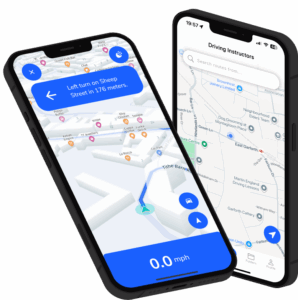
Consistent UK driving test practice with a navigation app puts you in exactly this scenario repeatedly, in a low-stakes environment, until handling a reroute feels routine rather than catastrophic. Apps like RouteBuddy are built specifically for this, simulating the real routes examiners use with voice-guided turn-by-turn directions so you rehearse the sat-nav experience on the actual roads before test day.
7. Reverse Manoeuvres: The One People Dread Most
The examiner will ask you to complete one of the following manoeuvres, as outlined on the driving test manoeuvres page:
- Parallel park at the side of the road
- Pull up on the right and reverse two car lengths
- Forward bay park and reverse out, or reverse bay park
Manoeuvre faults are common not because the techniques are difficult, but because the pressure of the test causes candidates to rush. Rushing leads to poor observations, and poor observations lead to faults.
The pull-up-on-the-right manoeuvre, introduced in 2017, still catches people out because it goes against the instinct most learners spend months building: never stop on the right. Knowing it is coming, practising it calmly, and being drilled on the observation sequence removes the shock of the instruction.
How RouteBuddy Turns Your UK Driving Test Practice Into a Real Advantage
RouteBuddy is a UK-based app and platform built specifically for learner drivers preparing for their practical test. It gives you access to the real routes used by DVSA examiners at test centres across the country, with turn-by-turn voice guidance that mimics the sat-nav experience of the test itself.
Rather than practising on random roads, you practise on the exact junctions, roundabouts, and stretches of road that the examiner is likely to take you on. The routes are kept up to date with current road layouts and speed limit changes, so what you practise reflects what you will actually face.
For learners in the final weeks before their test, this kind of specific, route-based UK driving test practice is one of the most efficient uses of time available. Every minute spent on those roads is a minute spent reducing uncertainty, and uncertainty is what fails most people.
Practical Steps to Improve Before Your Test
If your test is coming up in the next few weeks, here is how to structure your remaining UK driving test practice:
- Look up your test centre’s most common faults
- Read the full breakdown of what the examiner marks you on via the official driving test page
- Drive the test routes at least twice before test day, ideally at the same time of day as your test
- Focus your lessons on the specific junctions and manoeuvre spots on those routes
- Brush up on Highway Code rules for roundabouts, junctions, and signals on the Highway Code page
- Practise the sat-nav section using RouteBuddy to simulate your real test routes so following directions becomes automatic
- Do a full mock test with your instructor, covering the complete route without intervention
- Get enough sleep the night before; test anxiety is significantly worse when you are tired
The Bottom Line: UK Driving Test Practice
Most people who fail their driving test are not bad drivers. They are underprepared for the specific conditions of the test. The junctions, the roundabouts, the sat-nav, the pressure these are all manageable with the right kind of UK driving test practice. Passing first time comes down to familiarity, not talent. The more you have driven the roads the examiner uses, the more the test feels like just another drive, and that is exactly when you pass.