
Driving in Portsmouth, a vibrant city on the southern coast of England, combines busy coastal roads, narrow residential streets, and fast-moving A-roads. The Portsmouth Driving Test Routes are designed to assess your skills on varied roads, including multi-lane roundabouts, junctions, and high-speed roads. This guide provides 20 essential FAQs about the Portsmouth Test Centre to help you prepare confidently for your driving test.

👉 Practise the Portsmouth Driving Test Routes with RouteBuddy!
20 FAQs About the Portsmouth Driving Test Routes
1. Where is the Portsmouth Test Centre located?
📍1 Southampton Rd, Cosham, Portsmouth PO6 4SH, Portsmouth, United Kingdom.The test centre is located near the historic Fort Southwick, offering quick access to both residential and major road networks.
2. What types of roads will I encounter on the Portsmouth Driving Test Routes?
Expect a variety of roads, including:
- Busy A-roads like the A3 and A27
- Narrow residential streets
- Multi-lane roundabouts
- Coastal roads with heavy traffic
Some rural roads around the outskirts of Portsmouth
3. What challenges are common on Portsmouth routes?
The key challenges include:
- Multi-lane roundabouts near the A3
- Narrow lanes in residential areas
- Heavy traffic in peak hours
Sudden lane changes and speed limit transitions
4. What landmarks might I drive past during the test?
You may encounter:
- Fort Southwick
- Portsmouth Harbour
- The A3 junctions
- Portsmouth City Centre
5. What are the typical speed limits on Portsmouth Driving Test Routes?
- 20–30 mph in residential and school zones
- 40 mph on main roads like the A27
- 50–60 mph on A-roads and outskirts
Always keep an eye on speed limit signs, especially around busy or residential areas.
6. What types of junctions will I encounter?
Expect:
- T-junctions in residential areas
- Mini-roundabouts in suburban zones
- Larger roundabouts around the A3
- Busy crossroads near Portsmouth city centre
7. Are there difficult roundabouts on Portsmouth routes?
Yes, particularly around the A3, where large, multi-lane roundabouts are common.
Read more: DVSA Roundabout Guidelines
8. What parking manoeuvres should I prepare for?
You may be asked to perform:
- Bay parking at the test centre
- Parallel parking in tight streets
- Pull up on the right
- Reverse into a side road
- Emergency stop
Read more: DVSA Manoeuvres
9. How should I handle busy roads around Portsmouth Harbour?
Be prepared for:
- Pedestrian crossings in tourist areas
- Buses pulling in and out of stops
- Cyclists on shared lanes
- Sudden lane changes due to traffic flow
Read more: DVSA Road Safety – Pedestrians & Cyclists
10. Are dual carriageways included in Portsmouth test routes?
Yes, sections of the A3 and A27 are dual carriageways, where you’ll need to show good lane discipline and safe merging.
11. Will I need to manoeuvre the test?
Yes, you will likely be asked to complete one of the following:
- Bay parking
- Parallel parking
- Pull up on the right
- Emergency stop
12. How long is the Portsmouth driving test?
The test lasts around 40 minutes, including independent driving and one manoeuvre.
13. Can I practise Portsmouth Driving Test Routes before my test?
Absolutely. RouteBuddy provides accurate, turn-by-turn navigation to help you familiarise yourself with the Portsmouth Driving Test Routes.
14. How should I approach roundabouts on Portsmouth routes?
- Give way to traffic from the right
- Keep a safe distance from other vehicles
- Signal clearly for your exit
- Maintain lane discipline on multi-lane roundabouts
15. What common mistakes do learners make in Portsmouth?
Frequent errors include:
- Hesitating at busy roundabouts
- Failing to check mirrors when changing lanes
- Lane discipline issues on dual carriageways
- Over-speeding on wide roads
16. What should I bring to the driving test?
Make sure to bring:
- Provisional licence
- Theory test pass certificate
- Glasses or contact lenses (if required)
- A roadworthy car with L-plates
17. How does the weather affect the Portsmouth routes?
Rain can reduce grip on roundabouts and A-roads.
Low sun can cause glare, especially on coastal roads.
18. How should I deal with cyclists, buses, and large vehicles?
- Give cyclists plenty of space
- Be cautious around buses pulling in and out
- Always check mirrors before changing lanes
- Only overtake large vehicles when it’s safe
19. What happens if I fail the Portsmouth driving test?
The examiner will provide feedback. Use RouteBuddy to focus on areas where you struggled and practise before rebooking your test.
20. How do I book or change my Portsmouth driving test?
Use the DVSA online booking service to book, reschedule, or cancel your test.
Sample Guide of the Portsmouth Driving Test Routes
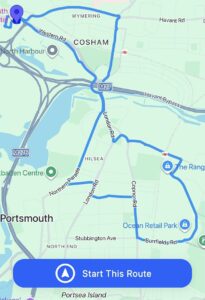
1. Leave the test centre on Compass Road → Southampton Road
- Lane: Stay left.
- Speed Limit: 30 mph.
- Tip: Watch for any vehicles entering the roundabout ahead.
2. Turn onto Northern Road → Portsbridge Roundabout → London Road
- Lane: Position for the exit early.
- Speed Limit: 30 mph.
- Tip: Stay steady through the roundabout and anticipate quick exits.
3. Move along Northern Parade → Magdalen Road → London Road
- Lane: Stay centred in your lane.
- Speed Limit: 30 mph.
- Tip: Residential areas, expect pedestrians crossing and parked vehicles.
4. Continue on Battenburg Avenue → Copnor Road → Burrfields Road
- Lane: Keep left unless road signs indicate otherwise.
- Speed Limit: 30 mph.
- Tip: Be aware of side roads and cyclists as traffic increases.
5. Head down Dundas Lane → Quartremaine Road → Airport Service Road
- Lane: Stay in your lane.
- Speed Limit: 30 mph.
- Tip: Junction-heavy section, be sure to check mirrors frequently.
6. Move onto Williams Road → Norway Road → Copnor Road
- Lane: Stay left.
- Speed Limit: 30 mph.
- Tip: Narrow sections with possible pedestrian crossings.
7. Continue on Old London Road → London Road → Portsbridge Roundabout
- Lane: Follow roundabout lane markings.
- Speed Limit: 30–40 mph.
- Tip: Roundabouts require early positioning and good observation.
8. Follow Western Road → Back to the Test Centre
- Lane: Position left for the final approach.
- Speed Limit: 5–10 mph within the test centre.
- Tip: End with a smooth, controlled parking manoeuvre.
Conclusion
The Portsmouth Driving Test Routes offer a true representation of the challenges you’ll face on the roads, from busy roundabouts to quiet suburban streets. By practising regularly and using RouteBuddy to familiarise yourself with the routes, you’ll increase your confidence and improve your chances of passing on your first attempt.
Stay focused, stay calm, and keep practising!