

Most learners know that picking up too many minor faults will fail their driving test. What far fewer realise, however, is that a single major fault ends your test immediately, regardless of how well everything else has gone. One lapse in judgement, one missed observation, one dangerous manoeuvre, and the test is over. Understanding the list of major faults driving test UK examiners record is therefore one of the most important things any learner can do before test day. It tells you exactly what the boundaries are, where the highest risks lie, and which moments in your test demand your sharpest attention.
This guide breaks down the eight most common instant fails, why they happen, and what you can do to make sure none of them appears on your scoresheet.

What Is the Difference Between a Minor and a Major Fault?
Before diving into the list of major faults driving test UK candidates face, it is worth understanding how the DVSA’s marking system works.
Minor Faults
Minor faults, officially called driving faults, are small errors that do not pose an immediate danger. As confirmed by the DVSA’s official guidance on driving test faults, you are allowed up to 15 minor faults before failing. However, if you accumulate three or more of the same minor fault, the examiner may upgrade it to a serious fault.
Serious and Dangerous Faults
Serious and dangerous faults are both classified as major faults. Either one results in an automatic fail. A serious fault could potentially cause danger, while a dangerous fault causes actual danger to you, the examiner, or other road users. In practice, both carry the same outcome: the test ends with a fail.
The List of Major Faults Driving Test UK Learners Face Most Often
1. Not Observing Properly at Junctions
Junction observation is the single most common major fault on the list of major faults driving test UK examiners record each year. According to the DVSA’s driving test fault statistics, tens of thousands of candidates fail every year due to emerging from a junction without adequate observation.
The fault typically happens in one of two ways. Either the candidate pulls out without checking properly, or they check but do not wait for a safe gap in traffic. Both are treated as serious faults at minimum, and dangerous faults if another vehicle has to brake or swerve as a result.
The fix is straightforward in theory but requires real practice to embed. Effective observation means turning your head clearly in both directions, taking enough time to assess the traffic, and only emerging when the gap is genuinely safe. Rushed observation, even if technically present, will not satisfy an examiner.
2. Not Using Mirrors Correctly Before Manoeuvres
Mirror faults sit consistently near the top of the list of major faults driving test UK candidates collect. The issue is rarely that learners forget to check their mirrors entirely. More often, the checks are too subtle for the examiner to see, or they happen at the wrong point in the sequence.
The DVSA expects candidates to use the mirror, signal, manoeuvre (MSM) routine consistently throughout the test. As outlined in the Highway Code, checking mirrors before signalling, before changing speed, and before changing direction is a fundamental requirement. Failing to do so clearly and at the correct moment will result in a serious fault.
The solution is to make mirror checks deliberate and visible. Turn your head just enough that the movement is unmistakable. During UK driving test practice, exaggerate the action until it becomes a natural habit.
3. Incorrect Road Positioning
Poor road positioning becomes a major fault when it creates a hazard for other road users. Taking the wrong lane at a roundabout, drifting across lane markings, or positioning incorrectly on approach to a junction can all result in an instant fail if the examiner judges it as dangerous.
Roundabouts are where this fault most commonly escalates from minor to major. Entering a roundabout in the wrong lane, or changing lanes on a roundabout without adequate observation, puts other drivers at risk. The Highway Code guidance on roundabouts is clear on correct lane discipline, but applying it correctly under pressure on an unfamiliar roundabout is a different challenge entirely.
This is precisely why route-specific UK driving test practice matters so much. Knowing which lane to take at a specific roundabout before you arrive at it removes the hesitation that leads to positioning faults.
4. Responding Incorrectly to Traffic Lights
Traffic light faults escalate to a major level when a candidate drives through a red light, moves on a red-amber signal, or responds so hesitantly to a green light that they create a hazard behind them. All three appear regularly on the list of major faults driving test UK examiners record.
Moving through a red light is an automatic dangerous fault with no exceptions. It is also, notably, one of the faults candidates most often attribute to distraction rather than poor ability. They were focused on something else, glanced up too late, or misjudged an amber. In every case, the result is the same.
Familiarity with the specific traffic light layouts on your test route reduces this risk significantly. Knowing that a particular junction has an awkward filter light, or that a set of lights is positioned further back than expected, means you are not reading the situation for the first time under pressure.
5. Loss of Control During a Manoeuvre
Reverse manoeuvres are high-risk moments on any driving test. Mounting the kerb during a parallel park, swinging too wide during a bay park, or failing to control the vehicle properly during a pull-up-on-the-right are all common entries on the list of major faults driving test UK candidates receive.
The key distinction is between a clumsy manoeuvre and a dangerous one. A clumsy manoeuvre that stays within safe limits might result in minor faults. A manoeuvre that mounts a kerb, enters oncoming traffic, or requires another road user to react will result in a serious or dangerous fault.
Candidates who rush manoeuvres under test pressure are the most vulnerable here. Slowing down, completing proper observations throughout, and prioritising control over speed are the habits that keep manoeuvres in the minor fault category.


6. Exceeding the Speed Limit
Speeding is an unambiguous major fault. There is no margin for interpretation. If you exceed the posted speed limit at any point during your test, the examiner will record a serious fault at minimum. Doing so in a way that creates danger, for instance near a school crossing or in heavy traffic, will result in a dangerous fault.
Interestingly, speeding faults on driving tests are often the result of distraction rather than deliberate risk-taking. A candidate who is focused on a complex junction ahead might not notice their speed creeping up on the approach. Similarly, candidates who are unfamiliar with a stretch of road may not register a speed limit change until it is too late.
Knowing your test route in advance, including where speed limits change, is one of the most effective ways to prevent this fault. RouteBuddy‘s up-to-date route data includes current speed limits, so you are never caught out by a limit change on an unfamiliar road.
7. Failing to Act on the Examiner’s Instructions Safely
The independent driving section of the test, where you follow sat-nav directions for around 20 minutes, creates a specific type of major fault risk. If a candidate misses a turn and then reacts dangerously, by braking sharply, reversing, or cutting across lanes, the reaction to the error becomes the fault rather than the error itself.
As the DVSA confirms in its guidance on the independent driving section, missing a turn does not result in a fail as long as you respond safely. What fails candidates is the panic that follows. A calm, safe response to a missed turn, even if it means continuing in the wrong direction briefly, will not cost you the test.
Practising the sat-nav section using RouteBuddy before test day builds the habit of responding calmly to unexpected instructions. The more familiar the experience feels, the less likely panic becomes.
8. Dangerous Interaction With Other Road Users
The final entry on the list of major faults driving test UK examiners record covers a broad category: any moment where the candidate’s actions force another road user to react. This includes pulling out in front of oncoming traffic, cutting up another vehicle when changing lanes, failing to give way to pedestrians at a crossing, or any other interaction that creates genuine danger.
These faults are serious precisely because they involve real risk to real people. Furthermore, they are the faults most closely associated with unfamiliarity, specifically with being on roads you have never driven before, in situations you have not mentally rehearsed. Consequently, targeted UK driving test practice on the actual test routes is the most direct way to reduce this risk.
How RouteBuddy Helps You Avoid Major Faults on Test Day
Every fault on this list shares a common thread. Each one is far more likely to occur when a candidate is encountering a road, junction, or situation for the first time under test pressure. Familiarity does not guarantee a pass, but unfamiliarity significantly increases the chances of a major fault.
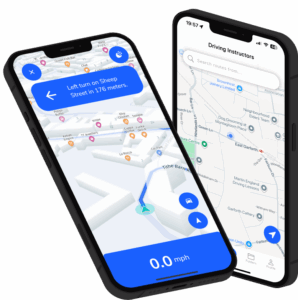
RouteBuddy gives learners across the UK access to the real routes used by DVSA examiners at test centres nationwide. Turn-by-turn voice guidance mirrors the independent driving section of the test, so you arrive on test day having already driven those roads, navigated those junctions, and handled those roundabouts. The unknown becomes the known, and that shift makes a measurable difference.
Practical Steps to Avoid Major Faults Before Your Test
- Study the full list of major faults using the DVSA’s official fault guidance
- Practise your test routes using RouteBuddy so junctions, roundabouts, and speed limit changes are already familiar
- Exaggerate your mirror checks during every practice drive until the habit is fully embedded
- Rehearse the sat-nav section using RouteBuddy to simulate your real test routes so following directions becomes automatic
- Review the Highway Code for junctions, roundabouts, and signals at GOV.UK
- Do a full mock test with your instructor on the real routes, with no prompting and in full test conditions
- Check your test centre’s most common faults using the DVSA’s statistics
The Bottom Line: List of Major Faults Driving Test UK
A single major fault ends your driving test, regardless of how well the rest of it goes. That is why understanding the list of major faults driving test UK examiners use is not optional preparation. It is essential.
The good news is that every fault on this list is preventable. None of them requires exceptional driving ability. All of them require awareness, preparation, and familiarity with the roads and situations you will face. With the right UK driving test practice behind you, none of these eight faults needs to appear on your scoresheet.


